


26-Aug-2025
Key Highlights:
Ethiopia's economy is one of the fastest-growing in Africa, thanks to its strategic trading partnerships with other countries. The nation’s import and export activities not only support its domestic industries but also strengthen its position in the global market.
From agricultural exports like coffee and oilseeds to imports of machinery, fuel, and industrial goods, Ethiopia’s trade partnerships reflect a diverse and dynamic economic landscape. Identifying Ethiopia's top trading partners provides valuable insights into the country’s growth trajectory, regional integration, and global trade connections.
In this blog, we will explore the list of Ethiopia's trading partners with updated Ethiopia's export and import, Ethiopia trade data, values, a case study and other key trends.
An overview of Ethiopia's import and export statistics is given in the table below:
|
Ethiopia Total Trade |
Detail |
Ethiopia import export data |
|
Trade Balance |
Overall Status |
Trade Deficit |
|
Ethiopia Export Data |
Total Export Value |
$2.85 billion |
|
Ethiopia Import Data |
Total Imports Value |
$17.9 billion |
|
Ethiopia trade partners |
Saudi Arabia |
United States |
Ethiopia import import-export data indicate a significant trade deficit as imports consistently outpace exports. According to Ethiopia import-export data, Ethiopia had a substantial trade imbalance in 2023, with $17.9 billion in imports and $2.85 billion in exports. While the bulk of the country's imports are machinery, oils, and mineral fuels, its top exports include coffee, tea, spices, and agricultural products.
Additionally, in 2023, the country's exports came to US$6.2 billion, while its imports came to about US$13.6 billion, as per Ethiopia Export Data. As a result, there was a US$7.4 billion trade deficit, as opposed to US$8.3 billion and US$9.4 billion in 2022 and 2021.
Now, it's time to explore the biggest Ethiopian trade partners!
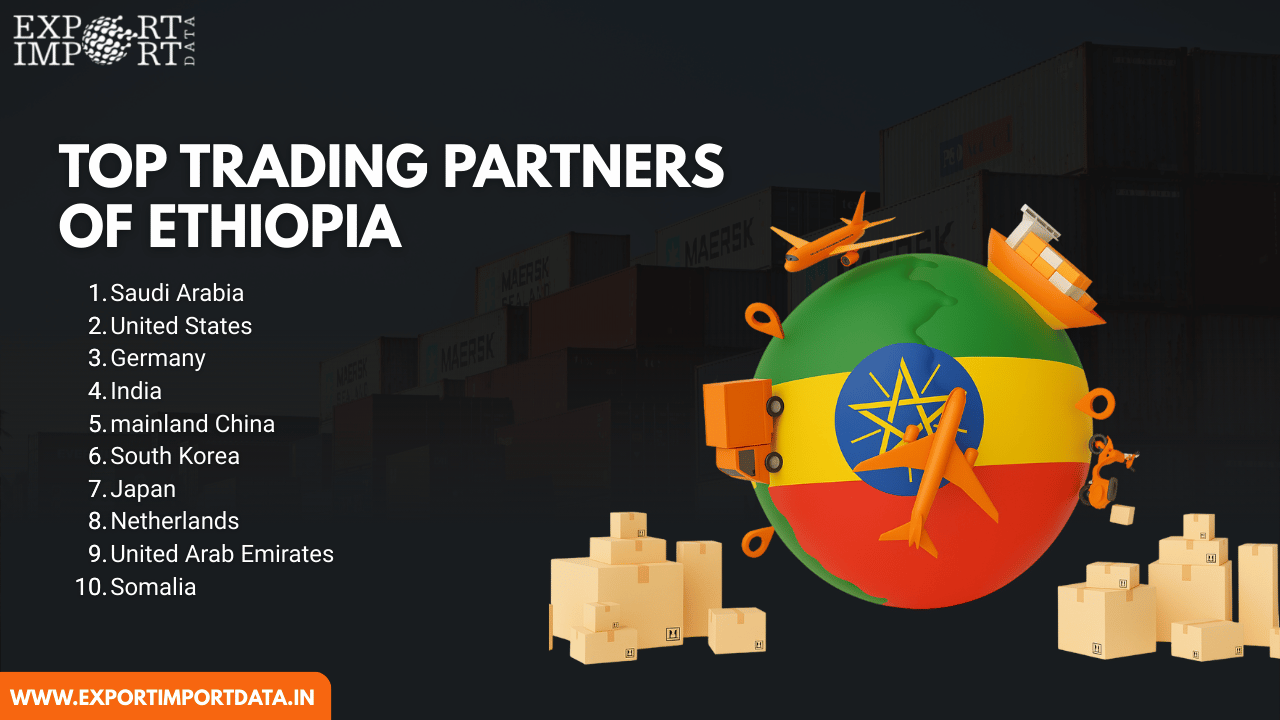
Below is the list of major Ethiopia trading partners:
Proceed to analyse top Ethiopia trade partners in a table containing values.
|
Rank |
Top Ethiopia Trading Partners |
Ethiopia import export data (US$ Million) |
% of Total Ethiopian Exports |
|
1 |
Saudi Arabia |
297.8 |
10.4 |
|
2 |
United States |
276.3 |
9.7 |
|
3 |
Netherlands |
218.6 |
7.6 |
|
4 |
United Arab Emirates |
163.8 |
5.7 |
|
5 |
Somalia |
142.1 |
5 |
|
6 |
India |
139.2 |
4.9 |
|
7 |
Germany |
135.3 |
4.7 |
|
8 |
mainland China |
131.6 |
4.6 |
|
9 |
South Korea |
116.1 |
4.1 |
|
10 |
Japan |
104.1 |
3.6 |
So, these are the leading trading partners of Ethiopia. Let's take a closer look at each of them:
Saudi Arabia is one of Ethiopia's most important trading partners; it mainly supplies the Ethiopian market with petroleum and associated goods.
Ethiopia provides the Kingdom with agricultural products, livestock, and coffee in exchange. Strong cultural and religious ties, as well as a sizable Ethiopian diaspora employed in Saudi Arabia, support their trade relations. In the labour and energy sectors in particular, the relationship is strategic.
The Netherlands is one of Ethiopia's most significant trading partners in Europe, especially in the horticultural and agricultural sectors. Ethiopia provides significant quantities of flowers, coffee, and vegetables to the Dutch market.Dutch companies also make significant investments in Ethiopia's floriculture industry, which promotes export growth and job creation. The relationship is based on development cooperation, trade, and private sector investment.
The UAE is one of Ethiopia's growing trading partners, with bilateral trade ranging from electronics to food items, machinery, and petroleum. Ethiopia provides coffee, meat, and other agricultural products to the United Arab Emirates.

The two countries have also signed several agreements to improve their investment and logistics cooperation. Companies from the United Arab Emirates are increasingly investigating opportunities in Ethiopia's construction and real estate sectors.
The United States and Ethiopia have a close trading relationship; the US exports agricultural products, machinery, and aeroplanes. Through programs like the African Growth and Opportunity Act (AGOA), Ethiopia exports leather goods, textiles, and coffee to the United States.
The United States is also a significant development partner, bolstering diplomatic and economic relations with Ethiopia through financing healthcare, education, and infrastructure.
The unofficial trade in textiles, food, and animals is the main focus of Ethiopia and Somalia's long-standing cross-border business relationship. Ethiopia supplies Somalia with power, khat, and manufactured goods.
Due to their proximity, communities near the common border rely on this trade. Even though informal trade is common, efforts are being made to plan and manage trade routes and agreements.
Ethiopia exports to India, a significant trading and investment partner, steel, textiles, machinery, and pharmaceuticals. Ethiopia supplies India with agricultural goods like pulses, oilseeds, and spices.
The bilateral relationship is strengthened even more by India's development assistance and credit lines. Indian companies operate in Ethiopia's manufacturing, agricultural, and educational sectors.
Germany is an important European partner from which Ethiopia imports flowers, coffee, textiles, and other agricultural products. Ethiopia imports automobiles, machinery, and other goods from Germany and chemicals. Germany also supports Ethiopia's development by offering technical assistance and programs for vocational training. The trade relationship is supported by strong cultural and diplomatic ties.
One of Ethiopia's largest trading partners and investors is China, which exports everything from electronics to textiles to construction equipment. Ethiopia exports raw materials, hides, and agricultural goods to China.
China has provided funding for significant infrastructure projects in Ethiopia, including telecoms, industrial parks, and railroads. For Ethiopia to achieve its objectives of industrialisation and economic modernisation, the partnership is essential.
Trade between South Korea and Ethiopia is growing, particularly in the areas of electronics, automobiles, and large machinery. Ethiopia diversifies its exports by importing coffee and agricultural products from South Korea.
Technical training, capacity building, and development assistance are also part of their bilateral ties. The collaboration emphasises historical and economic connections dating back to the Korean War.
Japan exports automobiles, machinery, and electronics to Ethiopia and imports coffee and leather goods from Ethiopia. The Japanese government backs Ethiopian development initiatives, especially those related to agriculture, education, and infrastructure.
The partnership is based on respect for one another, trade cooperation, and sustainable development objectives, and Japanese investment is still growing steadily.
Alem Tadesse, a 42-year-old procurement manager at an Ethiopian agro-processing company, faced challenges in sourcing reliable international suppliers. His company wanted to expand exports of processed coffee and sesame seeds while also ensuring access to essential imports like machinery and fertilisers.
However, Alem lacked accurate trade intelligence on Ethiopia’s top trading partners, Ethiopia’s exports and imports, or Ethiopia import and export data by country, making it difficult to negotiate competitive contracts and explore new global opportunities.
By using ExportImportData Solutions, Alem gained access to a list of Ethiopia trade partners and verified trade data on Ethiopia’s major import and export partners. The platform provided detailed insights into Ethiopia trading partners' products and Ethiopia’s leading trade relationships with countries such as China, the United States, Saudi Arabia, India, and the European Union.

With Ethiopia Import export statistics, Alem identified consistent buyers for agro-products and trusted suppliers of industrial machinery. The actionable intelligence allowed his company to diversify markets, strengthen supply chain reliability, and negotiate better pricing for Ethiopia's export products.
To access the list of current Ethiopian importers or buyers, you need to log in to the market research dashboard. ExportImportData.in is a leading market research platform.
You'll be able to obtain:
So, Ethiopia’s trading partners play a vital role in shaping its economic stability and global competitiveness. These relationships fuel industrial growth, enhance infrastructure development, and open new markets for Ethiopian products worldwide. As the nation continues to invest in logistics, manufacturing, and agriculture, its reliance on strategic partners will only deepen. Understanding Ethiopia’s top trading partners is therefore essential for businesses, policymakers, and investors seeking to tap into one of Africa’s most promising markets.
Moreover, if you still have any queries related to Ethiopia trading partners, Ethiopia export products, Export Import Data India, Ethiopia import data, Ethiopia trade data and Indian trade data, connect with ExportImportData.in and schedule a free live demo today.


Export Import Data solutions is one of the best online import export websites in India that provides trade data services and trading business information. Currently, Export import data is the best import export data provider and market research companies in India.
China was the largest import partner, and Saudi Arabia was a key export partner, along with the United States and the Netherlands.
Ethiopia's major trade is exporting agricultural products, particularly coffee, which is its single most important export and a significant source of foreign exchange earnings.
Ethiopia’s top 10 exports are coffee, oilseeds, gold, vegetables, livestock and meat products, spices, textiles and apparel, flowers and plants, cereals, and sugar and confectionery.
Ethiopia's major imports are mineral fuels and oils, such as refined petroleum, along with machinery and electrical equipment, and agricultural inputs like fertilisers and wheat.
According to Ethiopia import data, the total projected import value for 2024 was around $25.9 billion, driven by demand for food, energy, and industrial equipment.
Known for its high-quality Arabica beans, which are thought to be the origin of coffee, Ethiopia is Africa's largest producer.
